


WHY DOUBLE-INVERTED CURVATURE IS THE BACKBONE OF TENSILE STRUCTURES?

In the field of tensile construction, form does not just follow function: it guarantees the structure’s survival. To design a textile roof that is durable, aesthetic, and resilient, engineers and architects rely on a fundamental geometric principle: double-inverted curvature.
What is Double-Inverted Curvature?
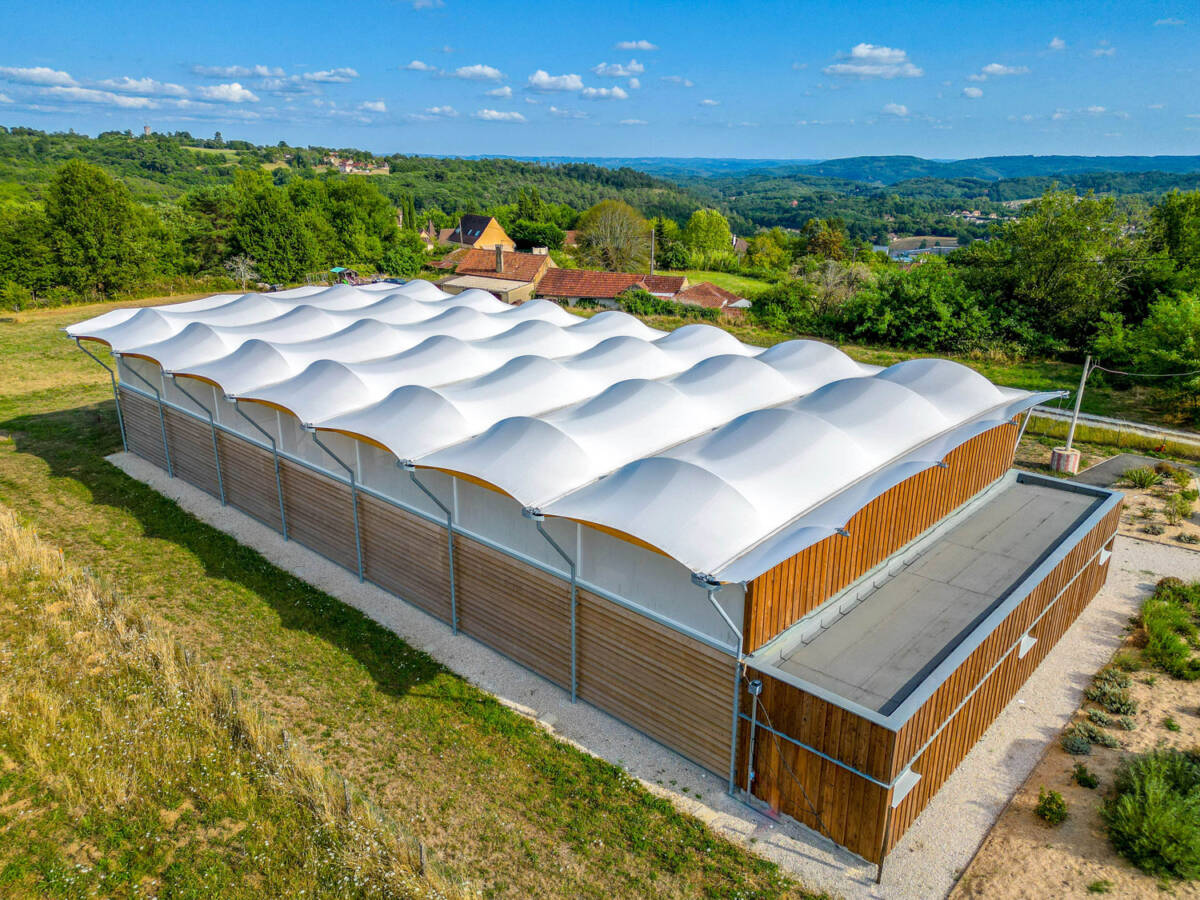
Unlike a traditional flat roof, a textile membrane must be tensioned to ensure long-term stability. This means it must be curved in two opposing directions. One curve points downward to shed water, while the other points upward to resist wind uplift, thereby stabilizing the fabric against external forces.
This shape, also known as anticlastic curvature, is often compared to a horse saddle or a “hyperbolic paraboloid.”

The Major Benefits of Anticlastic Curvature for Your Fabric structures
Utilizing this geometry is not a purely aesthetic choice; it is the only method to guarantee structural stability. By pulling the membrane between two high points and two low points, opposing internal tensions are created.
As a result, the textile membrane becomes capable of supporting loads (wind, snow, rain) without changing shape. It does not flutter and remains rigid during gusts; it naturally sheds rainwater, preventing “ponding” (the formation of water pockets) during heavy rain or snow.
Through this tensioning process, tensile architecture allows for covering vast areas—such as stadiums, sports canopies, and gymnasiums—with minimal material and support points. It provides exceptional lightness and clear spans.
Finally, correct curvature is the guardian of the fabric’s lifespan. An even distribution of stress across the fibers ensures the long-term integrity of the textile membrane.
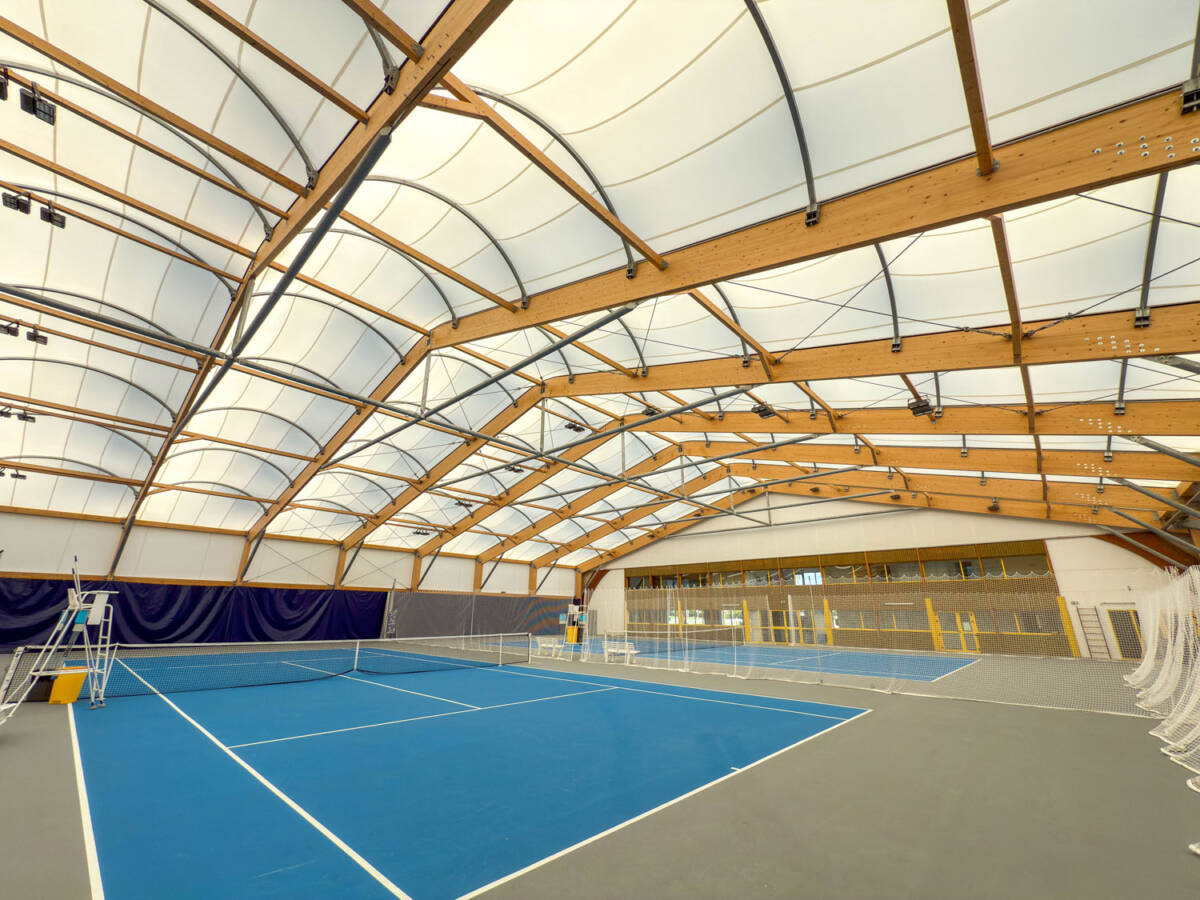
The Golden Rule for Tensile Roofs according to TensiNet
As highlighted by TensiNet, the leading European association for tensile architecture, the longevity of a lightweight structure depends on adequate prestress. Double-inverted curvature is therefore the industry standard and the only viable solution for tensile buildings.
According to their technical guidelines, a membrane without sufficient curvature will suffer from premature sagging, leading to fiber degradation and structural risks.
“Double curvature is the sine qua non for transforming a flexible material into a reliable load-bearing structure.” — Inspired by the principles of the TensiNet Design Guide.
At SMC2, mastering the engineering of the textile membrane and imaginating fabric structures is part of our DNA. We integrate these principles from the very beginning of the 3D design phase. Whether for a sports complex or a public space, tensile architecture by SMC2 pushes the boundaries of modern construction.